

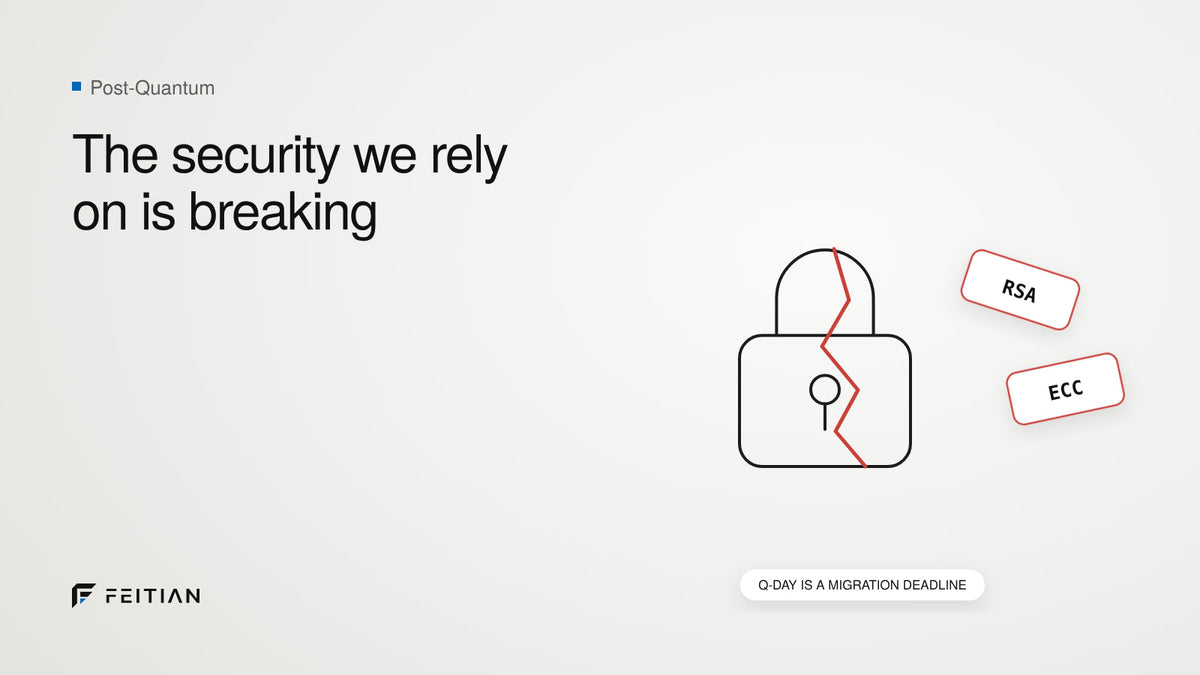
Every day, we trust our most private information to the internet. We send messages, make purchases, and share our lives online, all with the quiet confidence that our data is safe. For years, that trust has been well-placed, thanks to two powerful cryptographic algorithms: RSA and Elliptic Curve Cryptography (ECC). They are the foundation of our digital security.
But a fundamental shift is coming. A new kind of technology, the quantum computer, is on the horizon. These machines are being built to solve some of the world's most complex problems, but they also have a side effect we can't ignore: they could break the very encryption that protects our digital world.
We need to understand what's happening and what we can do about it.
The Encryption We've Trusted for Decades
To grasp the scale of this problem, it helps to understand how our current security system works. It’s based on creating mathematical problems that are easy to set up but incredibly hard to solve.
RSA: A Simple but Powerful Idea
RSA is one of the oldest and most trusted forms of encryption. Its security stems from a simple fact: multiplying two very large prime numbers is easy for a computer, but determining the original primes from the result is incredibly difficult. This creates a one-way street for information. It’s easy to create the lock, but almost impossible for a regular computer to pick it. That difficulty is what has kept our data safe for so long. The time it would take a normal computer to break a standard RSA key is measured in thousands, even millions, of years.
ECC: Stronger Security with Smaller Keys
Elliptic-Curve Cryptography (ECC) is a newer, more efficient method. It provides the same level of security as RSA but with smaller, faster keys, which is why it's used in so many of our phones and devices. Its security is also based on a mathematical problem that’s easy to do in one direction but extremely hard to reverse. While the math is different, the principle is the same: it creates a lock that classical computers can't break.
The Quantum Threat
For years, we’ve been safe because these locks were too hard to pick. But quantum computers don't follow the same rules. They have a special tool, an algorithm called Shor's algorithm, that is designed to solve the exact mathematical problems that RSA and ECC rely on.
A normal computer solves a problem one step at a time. A quantum computer, using the principles of quantum mechanics, can explore a huge number of possibilities all at once. It can see hidden patterns in the math that are invisible to regular computers. With this ability, Shor's algorithm can find the secret keys hidden inside RSA and ECC encryption with alarming speed.
Problems that would take a normal computer millions of years could be solved by a powerful quantum computer in just hours or days.
Which System Is in More Danger?
There's a debate about whether RSA or ECC is more vulnerable. Because ECC uses smaller keys, it technically requires fewer resources for a quantum computer to break. But this detail is less important than the bigger picture. When a quantum computer powerful enough to do this is built, both RSA and ECC will no longer be secure.
A New Generation of Protection
The world's leading cryptographers and scientists have been working on this problem for years. They've been developing a new set of encryption standards, known as Post-Quantum Cryptography (PQC), designed from the ground up to be safe from quantum attacks.
These new methods are based on completely different kinds of mathematical problems that we believe are hard for both regular and quantum computers to solve. After years of work and collaboration among experts worldwide, the U.S. National Institute of Standards and Technology (NIST) announced the first official PQC standards in 2024.
These new standards are the tools we will use to build a secure digital future.
What This Means for Us
The era of RSA and ECC is coming to an end. The technology that has protected us for so long will need to be replaced, and that transition will be one of the most important security upgrades in internet history.
We all have a stake in this transition, and it's time for everyone, from individuals to large organizations, to start preparing for a quantum-safe future.
Share:
Why PQC Matters for FIDO Keys
FEITIAN Is Going to NRF 2026